
On Grad School
An audit of the costs, returns, cheat codes, and joys.

Last week, I graduated from Columbia University’s School of International and Public Affairs with a Master’s Degree in Public Administration! I have many thoughts. This is the first among several reflections I hope to write about my time at graduate school. In this piece, I write about the “grad school experience” in aggregate. Although this piece touches on the following topics briefly, in subsequent essays, I hope to pull on threads like (i) getting an MPA v/s an MBA; (ii) managing money as a grad student; (iii) to be “technical” or not to be; (iv) finding employment; (v) how I would redo grad school if I could. If you would like me to write about any other aspect of grad school, please let me know!
TL;DR: Grad school is is a trade. The question is whether you know what you are buying, what you are giving up, and whether you are able to walk out justifying the price.

Yay!
I have found two things to be true:
Grad school is sold as transformation. This is a lovely word, because it is impossible to underwrite. A university can promise that you will “grow,” “evolve,” “find your purpose,” or “join a community of leaders,” and none of these claims can be marked to market.
Grad school functions like a financial instrument. This may sound too uncomfortable to mention at admitted-students days, where everyone waxes about intellectual community, or policy leadership, or the coffee shop near campus. You are, in some sense, “buying” education. But, you are also buying geography, time, brand, access, optionality, and a socially acceptable explanation for why your life is briefly under construction.
The actual “product” is, more or less, four things in a trench coat, stacked unevenly on top of each other.
Grad school is an expensive plane ticket.
This is the cynical version, so let us start here. Grad school provides geographic arbitrage. You are paying for the right to be in a place where certain things happen more often. New York. London. Boston. Palo Alto. D.C. These are centers of excellence, and access to them affords opportunities no job board can truly surface.
In my case, Columbia was as much the “Columbia” of it all, as it was New York City. It was being able to watch India’s External Affairs Minister address the UN; or the peculiar accessibility of a city where a class could end at 5:30 p.m. and, by 6 p.m., you could be in a room halfway across the borough listening to a Nobel Laureate argue about AI and job loss; or having a chance encounter with a founder become a professional thread; or convincing myself that walking 20 blocks in dress shoes counted as both networking and cardio. I wanted to consciously buy proximity to a labor market, a conversation, and a version of myself that may not have emerged as easily elsewhere. Was that worth it? On the plane-ticket ledger, yes. Besides, moving to New York for grad school, and then living entirely inside the PDF folder of your homework is like buying a Bloomberg Terminal to check the weather. Which leads us to…
Grad school is a subscription to upskill.
This is the part universities most want to sell you because it sounds noble and is easiest to photograph. Here is a classroom. Here is a professor. Here is a student nodding at a slide titled “Framework.” Surely, value is being created! And it is! Just not as much as everyone pretends, I think.
I found that coursework is the thinnest layer of value in grad school. I am not saying that coursework is entirely useless. I found a lot of it to be excellent. A good class can really, really change how you think. A good professor can save you years of intellectual wandering. A good problem set can ruin your weekend and improve your soul.
In no particular order, here’s a list of the most universe-expanding classes I had the privilege of taking at Columbia:
Then why is value in coursework so thin? My honest assessment is that (most) technical knowledge is now cheaper than tuition. You can learn statistics, machine learning, international finance, trade theory, or Python from books, YouTube, GitHub, and the collective unpaid labor of strangers on the internet. So I don’t think the classroom is valuable because the information is scarce. (Un)fortunately, I think it is valuable because the environment makes the information costly enough that you take it seriously. This is a really stupid human bug. But it is real. I learned things at Columbia that I could theoretically have learned alone. But the word “theoretically” is operative, as it often is in both economics and personal development.
Grad school is an opportunity to think long and hard.
This feature is probably the least advertised. I get it. It sounds like unemployment with better branding. For two years, “I am in grad school” is a complete answer. Why are you reading about AI policy? Grad school. Why are you writing an essay about sports and assimilation? Grad school. Why are you cold-emailing think-tank heads? Grad school. Why are you in Seoul at a conference talking about ideas that did not exist in your life three years ago? Grad school.
I found that all that time gave ambiguity some structure. It gave me enough “institutional cover” to explore without looking lost. This is underrated! In normal adult life, wandering has to be justified by revenue. In grad school, wandering can be called research. For me, this mattered a lot. It gave me the space to write, to build a voice, to work on technical AI governance, to take ideas seriously before anyone else had a reason to. Of course, time is expensive. This is why it is precious. “Bought time to think” is beautiful until you remember the verb is “bought.”
Grad school is the relationships you made along the way.
Ugh. What a cliche. I know. But this is the least cynical and most durable part. I don’t think my LinkedIn connections capture the true “value” of my “network.” To be fair, I don’t think the alumni portal does either (though the alumni portal will bravely pretend.) Grad school provided a surface/pretext/excuse/reason for repeated, low-friction interaction with people who are also trying to become something.
Professors, peers, guest speakers, they all matter with varying degrees of importance. The person sitting next to you in a class you almost dropped may matter in five years in a way you cannot price today. This is the closest grad school gets to venture capital. Most interactions go nowhere, a few compound absurdly, and nobody knows which is which at the time. The best versions of these happenstances, in my experience, have not been purely transactional. It is not the “Can I pick your brain?” message – which, by the way, is one of the most violent phrases in the English language.
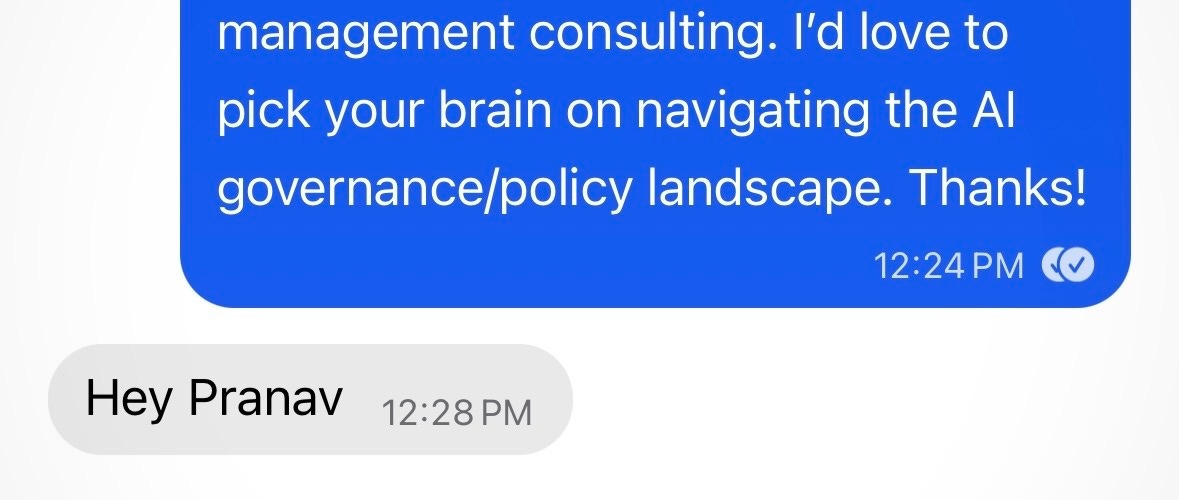
Guilty.
I think it is some vector sum of proximity + shared work + time. You build trust by doing things with people before either of you knows what the thing is worth. This was the part I underestimated. I thought the degree would confer credibility. I would like to think it did, a bit. The people conferred possibility. They widened the field of what seemed normal for me to attempt.
The Two ROI Ledgers
The annoying thing about grad school is that there are two ROI ledgers, and both are real.
The Financial Ledger
On this ledger, the math is brutal. It needs to be, so that it can be instructive. Tuition + living costs + opportunity cost go in. Salary delta, employment probability, geographic access, visa strategy, brand value, and career optionality come out. You do not need to be a private-equity associate to understand that if the left side is large and the right side is vague, you may have purchased an identity crisis.
I think the most important number is opportunity cost. It sucks. It contributes little emotionally and owns a large part of the cap table. If you have a consulting offer, a policy job, a central banking role, a tech role, or any plausible “real job” alternative with decent pay, then grad school must clear that bar. This cannot only be “spiritual.” The perceived delta has to be believable, and quantifiable. The optionality has to be specific. “I will have more opportunities” is not a plan. “This degree lets me enter X roles from a stronger platform, with access to specific internships, networks, and employers” is a much better investment thesis.
For me, the privilege of having (i) savings, in a currency with favourable exchange rates against the U.S. dollar, (ii) generous payments from fellowships and on-campus employment, and (iii) support from family, helped pave a sustainable economic path to even think about attending grad school. Without it, the same decision could have looked much, much more like a beautifully branded debt trap. Grad school is not inherently rational. My ledger had inputs that many people’s ledgers do not. It is not a privilege I take lightly.
The Intangible Ledger
I can go on and on about this ledger, because it is my favourite. A new city. The friends who made the city less lonely. The joy of experiencing grad school alongside your partner, comparing notes across programs. Besting your 10k PR in Central Park. Summer. Fall. Winter. Spring. Repeat. The Google Calendar request needed to schedule dinner with friends who live 14 minutes away. Learning which subway exits matter. Developing strong opinions about bagels. Discovering that “let’s do something low-key” can still cost $47.

White-out in Central Park. I have never seen anything like it.
These things do not show up in a compensation band. They may not be “benefits” in the HR sense, but they are, still, benefits in the deeply human sense. They emerged from the specific configuration of place, people, timing that grad school created. A different decision might have produced a cleaner spreadsheet. It would not have produced this life. I find so much confidence, healing, and unbridled pleasure that came from being temporarily surrounded by people who also think the world is a system and are deranged enough to try to improve it.
Of course, the two ledgers conflict!
The financially optimal play may be to take the cleanest job, earn immediately, avoid debt, and compound income. There is dignity in that. There is also a version of me that would have become more polished and less interesting. The intangible-optimal play may be to read, write, travel, over-invest in ideas, and say yes to every strange opportunity. There is romance in that. There is also a version of me that would have become fascinating and insolvent.
Grad school only works if you do not let either book become propaganda. The financial ledger keeps you from mistaking ✨vibes✨for planning. The intangible ledger keeps you from mistaking compensation for life. Both books must balance; maybe not every month or even every year. But eventually, they must!
The Cheat Codes
You can “game” grad school in the same way you can “game” tax law or airport security lines (this is not legal advice, I promise). What I mean is, every institution is full of some sorts of “hidden” levers, and you should develop a good sense to pull them.
Do not pay sticker price.
Scholarship/fellowship/employer sponsorship/assistantship/ external funding; whatever form it takes, the discount matters more than almost everything else because it changes the entire trade.
A degree at full price and the same degree at half price are not the same product. They have the same logo, but different risk profiles. The first one is a leveraged bet, and the second one may be a call option. This cashes in on the plane-ticket lens. If grad school is partly a way to move yourself into a better market, then reducing the cost of that move is everything! Do it! Nobody brags about buying an overpriced plane ticket. Somehow people brag about doing the same thing with tuition.
Get paid on campus.
Between TA roles/RA roles/research centers/admissions jobs/program assistantships, do anything that gives you money and proximity at the same time. This is not just about the cash, though the cash is “nice to have” in the same way oxygen is “nice to have.” Your mileage may vary, but I found that it is a great pretext for being closer to faculty, institutional information, projects, and what I call the informal economy of opportunity. Universities are full of things that are technically public but practically hidden.
They also have concrete real-world effects! This is, of course, context-dependent. But for example, in the U.S., the sooner you get a job, the sooner you can get a social security number. The sooner you get an SSN, the sooner you can start building a credit history, applying for cards, renting apartments with less ritual humiliation, and generally participating in the American financial system. Sometimes the first step toward self-actualization is payroll.
I also think being a student-employee primes you to become an employee-employee again. Your schedule stops being anchored entirely around the whims of maybe-half-studying for an exam two weeks out. You have problem sets to correct, office hours to hold, emails to answer, administrative tasks to complete. This can sound annoying. It is annoying. But it also creates structure. And structure, when you are in graduate school and periodically wondering whether you are simply drifting with better stationery, can be very, very comforting.
I was a teaching assistant for an advanced statistics class and a Python class, and I think I learned more teaching those concepts than I did the first time learning them. This is partly because students ask questions with the innocence of people who have not yet learned which confusions they are supposed to hide. They force you to explain the thing beneath the thing. You cannot just say “the regression controls for that” and hope the room moves on. You have to know what “controls” means, what “that” means, and what it does not mean.
Summers matter.
Internships/research fellowships/fieldwork/policy shops/labs/think tanks/startups/multilateral organizations/volunteering/sitting with your thoughts and documenting them: a summer well spent is a good indicator of what the “market” believed you could do with your transcript.
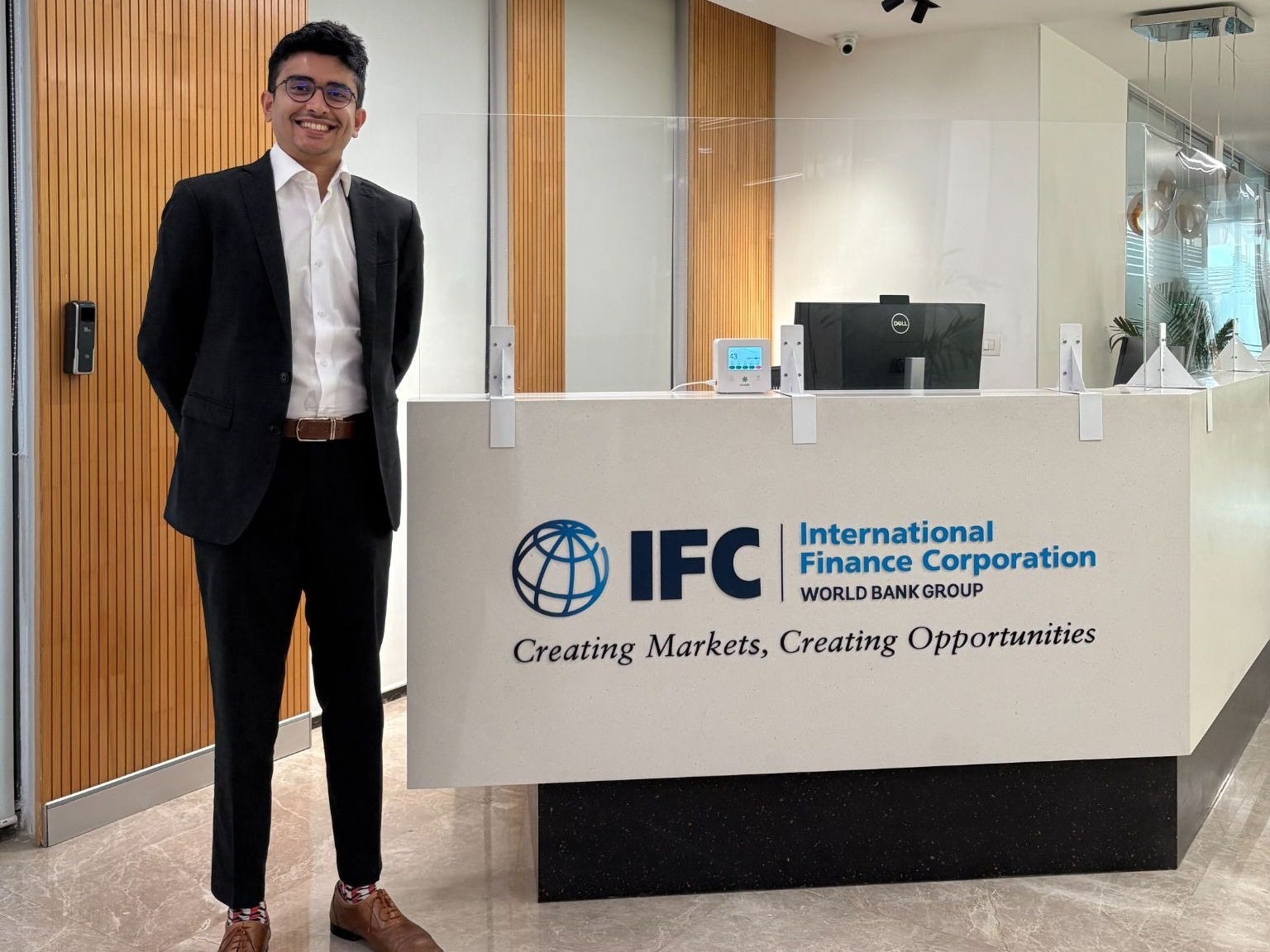
I need longer work trousers.
My internship with IFC, and fellowship with MATS changed the shape of my degree. IFC took me back to India. Sure, I was visiting home with a suitcase and unresolved nostalgia, but I was also working on climate finance from inside a multilateral institution! I was so happy to do the hard, practical work of turning large moral nouns like “inclusion” and “sustainability” into actual implementation pathways. MATS changed me in a different direction. It gave me a bridge from financial regulation into AI governance. I could model frontier AI labs like systemically important institutions, as entities whose failures could cascade and whose incentives needed scrutiny. Above all, it let the central banker in me survive the pivot to AI with dignity.
Refuse busywork.
Let’s be real. Almost every assignment, report, or academic artefact, can be started and completed entirely by LLMs. That approach might fetch you (i) the grade you want, or (ii) time to do the thing you actually want to do. But, I also found that it has, and likely will never, fetch me the satisfaction of working for the discipline of working.
Every assignment is a free option to work on a problem you actually care about. Some folks waste this and then complain that school felt irrelevant. This is not entirely their fault! Universities are very good at making intelligent people produce 2,500 words on topics neither party will remember. But you can usually bend the prompt. An International Trade paper can help you question your home country’s tariff policies. A machine learning assignment can become a question about credit access. A policy memo can become a draft of an idea you want to publish. I found that the trick is to stop treating assignments as submissions and start treating them as prototypes. Submit the thing, yes. But also ask: does this feed the person I am becoming?
This cashes in on the upskilling lens. Yes, coursework is thin if you passively receive it. It only hardens when you force it to touch your actual questions.
Reapply.
There is always a next cycle. This sounds banal, but it is emotionally difficult because rejection makes the strongest adults behave like children (me). A think tank says no and suddenly the person who wanted to reform global governance is lying face down, convinced the entire international order has spoken (also me). But reapplying is free optionality. I think the first attempt is pure recon. So many times, I have come back heartbroken from rejection but also having learned the language, the criteria, the people, the timing, and the hidden expectations. Grad school is full of second doors. Many people treat the first no as information about their worth. I hope I no longer am this person – but this is always easier said than done.
The Verdict
So, is grad school worth it?
The irritating but correct answer is: only if you can integrate it.
It is not worth it because of the brand alone. Brands decay when they are not attached to substance.
It is not worth it because of the classes alone. Classes are increasingly unbundled.
It is not worth it because of the network alone. Networks punish people who show up asking to only extract value.
It is not worth it because of the time alone. Time without direction becomes very expensive drifting.
Grad school becomes worth it when the plane ticket, the upskilling, the thinking time, and the people protocol combine into a more “comprehensive you.”
Ughhh. I knowwww. That phrase sounds like something an admissions office would put over a photo of students laughing near a diverse picnic blanket. But, by the time you walk out, you should be more legible to:
Yourself;
Future employers;
Future collaborators; and
To the world you claim you want to affect.
You should be able to say: I went in as X. I used the city to access Y. I used classes to build Z. I used time to think about A. I used people to test and sharpen B. I leave as someone who can credibly do C.
My version of this looks like:
I went in as a former central banker with a vague hunch that the next big regulatory problem would not look like the last one.
New York put me closer to the conversations I cared about: U.S. policy, AI governance. Classes gave me tools I did not fully have before: statistics, machine learning, international finance, political economy, trade, accounting, and the habit of making a vague belief survive scrutiny.
I used the time to think about what financial regulation had taught me about AI: that (i) powerful systems fail systemically before they fail individually, (ii) that incentives matter more than mission statements, and (iii) that governance needs stress tests and boring institutional processes as much as it needs principles.
People – professors, classmates, editors, researchers, interviewers, friends, and the occasional, mercifully generous stranger on LinkedIn – helped me to test whether this was a personality quirk or an actual career.
I think I leave as someone who can credibly work on policy, as someone trying to bridge frontier technology, public institutions, and systemic risk.
If you cannot complete that sentence, grad school may still have been meaningful! It may even have been beautiful! Grad school may still, of course, have been valuable. But it becomes much harder to explain what the value was, and whether it justified the cost.
The people who should not go are not the people without perfect clarity. Nobody has perfect clarity, and the people who claim they do are often the most alarming. The people who should not go are the ones who think the institution will do the integrating for them. It will not. The university will happily sell you the pieces separately: the city, the courses, the time, the network, the tote bag. Assembly is not included.
Grad school is a financial instrument. It can hedge a career transition, buy a call option on a new geography, lever up your human capital, and create strange intangible returns that make the model harder to audit. But like all instruments, it has risks! So many risks. It has duration risk, liquidity risk, overconfidence risk and prestige risk. Most concerningly, it carries the risk that you mistake being admitted for being transformed.
LLM Use Disclaimer
I used Claude’s Opus 4.7 model to sketch the rough outline of this essay. You can find the transcript of that conversation here.
Parts of this essay have also been edited with the help of OpenAI’s GPT-5.5 model, where sentence structures felt clunky. For example, I originally wrote:
Also, I think being a student-employee primes you to be an employee-employee in the future. Your schedule is not anchored around the whims of maybe-half-studying for an exam two weeks out; you have problem sets to correct, office hours to hold, administrative tasks to complete.
ChatGPT edited the sentence as follows:
Being a student-employee primes you to become an employee-employee again. Your schedule stops being anchored entirely around the whims of maybe-half-studying for an exam two weeks out. You have problem sets to correct, office hours to hold, administrative tasks to complete.
Great informative read! Almost want to go back in time and re think my masters.
You’ve outdone yourself today with this one and somehow, you keep getting better every day. Keep going!